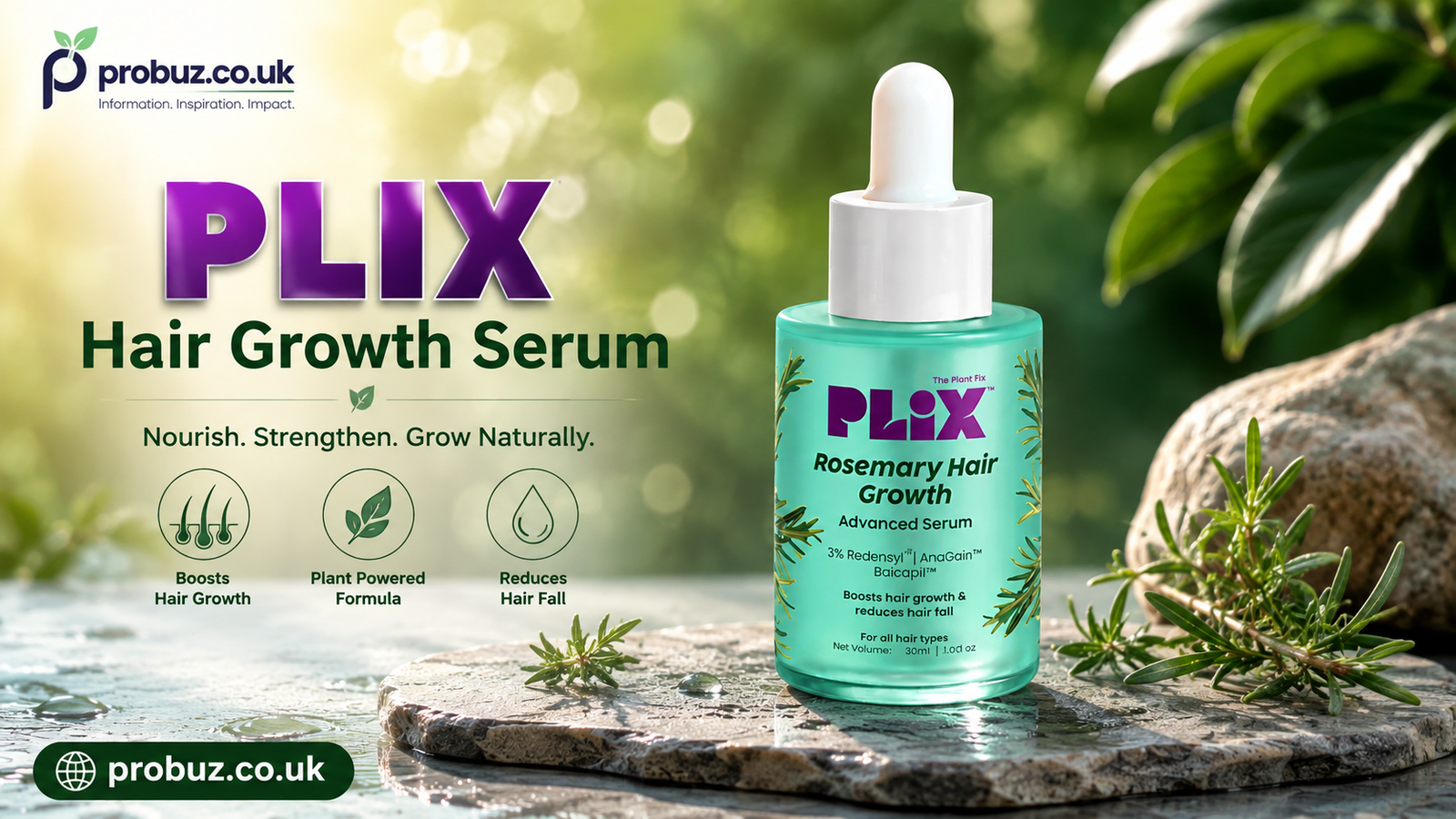
Plix Hair Growth Serum:
Hair fall is one of those problems that can make a simple shower or hair-brushing session feel surprisingly stressful. That’s why products such as Plix Hair Growth Serum attract so much attention. The promise is appealing: apply a serum to your scalp regularly and potentially see less shedding and better-looking hair density over time.
But there’s a more useful question than simply asking whether the serum “works.” What exactly is in it, what can those ingredients realistically do, and when should someone consider a medical hair-loss treatment instead?
Plix currently sells several hair-serum formulations, with its Rosemary Hair Growth Serum built around ingredients including Redensyl, AnaGain, Baicapil and rosemary. The company’s current product pages describe the serum as dermatologically tested and position it as a hair-fall and density product.
The important distinction is that a cosmetic hair serum shouldn’t automatically be treated as equivalent to a clinically established treatment for hair loss. If your hair is gradually thinning because of a medical or hereditary condition, identifying the cause matters just as much as choosing a product.
Quick Answer: Does Plix Hair Growth Serum Work?
Plix Hair Growth Serum may be a reasonable cosmetic scalp-care option for people dealing with mild hair fall or wanting to support the appearance and condition of their hair, but its results shouldn’t be compared directly with established medical treatments such as minoxidil.
The current Plix Rosemary Hair Growth Serum contains 3% Redensyl, 3% Baicapil, 3% AnaGain in some listed formulations, plus rosemary and other supporting ingredients. However, Plix’s product pages aren’t completely consistent about the AnaGain concentration across formulations, so shoppers should check the ingredient panel on the exact bottle they’re buying.
That detail matters. “Plix hair growth serum” isn’t necessarily one unchanging formula.
What Is Plix Hair Growth Serum?
Plix is an Indian personal-care brand that sells hair, skin and wellness products. Its hair-serum range includes products marketed for reducing hair fall and supporting hair growth and density.
The Rosemary Hair Growth Serum is the formulation most people are likely referring to when they search for Plix hair growth serum. The current product listing highlights Redensyl, Baicapil, AnaGain and rosemary.
The full ingredient list is considerably longer. Depending on the formulation, it includes plant extracts, amino acids, caffeine, proteins, panthenol, glycerin, oils and preservatives alongside the highlighted actives.
That tells you something useful: this isn’t simply rosemary oil in a bottle. It’s a multi-ingredient cosmetic formulation designed to be applied directly to the scalp.
Key Ingredients in Plix Hair Growth Serum
Redensyl
Redensyl is one of the headline ingredients in Plix’s formula. The company markets it as an ingredient intended to support hair growth and density.
Redensyl is not the same thing as minoxidil, and it shouldn’t be presented as though it has the same level of clinical evidence. That’s one of the biggest points consumers should keep in mind when reading hair-growth marketing.
AnaGain
AnaGain is another featured ingredient. Plix says it is derived from organic pea sprouts and is intended to support the hair-growth cycle and reduce shedding.
The exact concentration can differ between Plix product listings. Some current pages show 3%, while another Plix listing describes 4%. For that reason, checking the label of the particular product is smarter than relying on a generic description of “Plix serum.”
Baicapil
Baicapil is a botanical blend that Plix includes in its formulation and associates with hair density and reduced hair loss. The company identifies it as a plant-extract blend sourced from Spain.
Again, the sensible approach is to regard it as a supporting cosmetic active rather than assume that a percentage printed on a bottle guarantees a particular amount of new hair growth.
Rosemary
Rosemary is perhaps the ingredient that makes the product easiest to recognize. Rosemary has become popular in hair-care products because of interest in its potential effect on the scalp and hair follicles.
But “natural” doesn’t automatically mean “proven,” and rosemary shouldn’t be treated as a guaranteed solution for hereditary hair loss.
How Should You Use Plix Hair Growth Serum?
The basic idea behind a scalp serum is simple: it needs regular contact with the scalp rather than merely being spread through the hair lengths.
A sensible routine is:
Apply the serum directly to the scalp, particularly in areas where you want to target hair fall.
Spread it gently with your fingertips.
Avoid aggressive rubbing or scratching.
Follow the frequency and quantity stated on the product packaging.
Give the routine enough time before judging the result.
Consistency matters, but patience matters too. Hair grows slowly, so expecting a dramatically different hairline after a few days is unrealistic.
Plix itself recommends patch testing for its hair-care products, which is particularly sensible if your scalp is sensitive or you’ve reacted to cosmetic products before.
How Long Does Plix Hair Growth Serum Take to Work?
This is where hair-growth marketing can create unrealistic expectations.
Plix currently promotes claims such as visible new hair growth in 84 days on one of its product pages. That should be understood as a product claim, not a guarantee that every person will see new growth within 84 days.
Hair growth varies enormously depending on genetics, age, nutrition, hormones, stress, scalp conditions and the underlying reason for hair loss.
If you’re using a cosmetic serum, I’d judge it over several months rather than several weeks. Take photographs under similar lighting every month. That gives you a much better comparison than relying on memory.
Plix Hair Growth Serum vs. Minoxidil
This is probably the most important comparison for someone experiencing genuine thinning.
Minoxidil has substantially stronger clinical support for certain forms of hair loss. The American Academy of Dermatology says minoxidil can stimulate hair growth and help prevent further hair loss, although it doesn’t restore an entire head of hair. Results can take months and continued use is generally needed to maintain the benefit.
Plix, by contrast, markets its serum as a minoxidil-free formula based on ingredients such as Redensyl, AnaGain and Baicapil.
That doesn’t make Plix “bad.” It simply means you’re comparing two different categories of products.
| Plix Hair Growth Serum | Minoxidil |
|---|---|
| Cosmetic scalp/hair product | Established medical treatment for certain hair-loss conditions |
| Uses ingredients such as Redensyl, AnaGain and Baicapil | Uses minoxidil |
| Marketed for reducing hair fall and improving density | Can stimulate hair growth and reduce further loss |
| Evidence for the complete formulation is more limited | Considerably stronger clinical evidence |
| Minoxidil-free | Contains minoxidil |
If your hair is visibly thinning at the temples, crown or part line, especially progressively, it’s worth discussing the cause with a dermatologist rather than relying exclusively on a cosmetic serum.
Who Might Consider Plix Hair Growth Serum?
Plix may make sense for someone who:
Wants a lightweight scalp serum as part of a hair-care routine
Has noticed increased shedding but doesn’t know the cause
Wants a minoxidil-free product
Is interested in cosmetic ingredients such as rosemary and botanical extracts
Understands that results aren’t guaranteed
Is willing to use the product consistently
It’s less sensible to treat it as your only solution if you’re experiencing rapid or severe hair loss, bald patches, scalp inflammation, or a clearly receding hairline.
Those situations deserve a proper evaluation.
What Are the Potential Downsides?
The biggest downside isn’t necessarily the ingredient list. It’s the possibility of expecting more from a cosmetic serum than it can realistically deliver.
A few other considerations are worth keeping in mind.
Scalp irritation: Even products marketed as gentle can cause irritation in some people. Stop using a product if you develop significant burning, swelling, rash or persistent itching.
Ingredient sensitivity: The formula contains multiple botanical extracts, oils and other ingredients. More ingredients mean more potential sources of sensitivity for someone with a reactive scalp.
Results vary: Two people can use the same serum and have completely different experiences because hair loss has many causes.
The cause may be elsewhere: Stress, illness, nutritional deficiencies, hormonal changes, medications and hereditary pattern hair loss can all contribute to shedding. A serum won’t necessarily address the underlying problem.
Common Mistakes People Make With Hair Growth Serums
One of the easiest mistakes is applying the product to the hair instead of the scalp. If the goal is to target the scalp, that’s where the product needs to go.
Another mistake is using too much. More serum doesn’t automatically mean faster growth. Follow the manufacturer’s directions.
Then there’s the biggest mistake: switching products every few weeks.
Hair doesn’t work on a two-week marketing cycle. Constantly changing products makes it almost impossible to know whether anything helped.
Finally, don’t judge your hair exclusively by the amount you see in the shower. Hair appearance changes with styling, washing frequency and lighting. Consistent photographs are a much better way to track gradual changes.
Expert Insight: Look at the Cause Before the Serum
Here’s the practical point that often gets lost in product discussions: hair fall is a symptom, not a diagnosis.
If your hair has suddenly started shedding much more than usual, the right question isn’t just “Which serum should I buy?” It’s “Why is this happening?”
Temporary shedding can occur after periods of stress or illness. Pattern hair loss behaves differently. Scalp conditions have their own treatment requirements. Nutritional or hormonal problems may need medical attention.
That’s why a serum can be useful as part of a routine without being the entire answer.
If you have progressive thinning, a widening part, a receding hairline, visible scalp at the crown, or persistent shedding, consider speaking with a dermatologist. The American Academy of Dermatology specifically recommends diagnosis as part of determining appropriate hair-loss treatment.
Is Plix Hair Growth Serum Worth Trying?
For someone looking for a minoxidil-free, cosmetic hair serum, Plix has a fairly interesting ingredient profile. The combination of Redensyl, AnaGain, Baicapil, rosemary and supporting ingredients gives the product a more targeted formulation than a basic hair oil.
But I’d keep expectations realistic.
Don’t buy it expecting a guaranteed transformation. Don’t assume “3%” automatically means the product is clinically proven to regrow hair. And don’t use a cosmetic serum as a substitute for medical evaluation when hair loss is significant or progressing.
The best way to approach it is as one part of a broader hair-care strategy.
Final Takeaway
Plix Hair Growth Serum is best viewed as a cosmetic scalp-care product, not a guaranteed hair-regrowth treatment. Its current Rosemary formula combines ingredients such as Redensyl, AnaGain, Baicapil and rosemary, making it more targeted than a conventional hair oil.
If your hair fall is mild and you’re interested in a minoxidil-free routine, it may be worth considering. If you’re losing hair progressively, however, don’t let a serum delay finding out why. The cause of hair loss determines what treatment has the best chance of actually helping.
Visit also : Brasssmile com: What the Website Is, What It Covers, and What Readers Should Know
Does Plix Hair Growth Serum really grow hair?
Plix markets its serum for reducing hair fall and improving hair density, and its formula contains ingredients such as Redensyl, AnaGain and Baicapil. However, individual results can vary, and the evidence for the complete Plix formulation shouldn’t be equated with the stronger clinical evidence behind established treatments such as minoxidil.
Does Plix Hair Growth Serum contain minoxidil?
The Plix Rosemary Hair Growth Serum is marketed as a minoxidil-free formula. Its listed highlighted ingredients include Redensyl, AnaGain, Baicapil and rosemary.
How often should I use Plix Hair Growth Serum?
Follow the directions on the specific product packaging you’re using. Apply it to the scalp rather than simply coating the hair lengths, and avoid using more product than recommended.
How long does Plix Hair Growth Serum take to show results?
Plix promotes visible new hair growth in 84 days on one current product page, but that’s a company claim and shouldn’t be interpreted as a guaranteed timeline for every user. Hair growth is slow, so evaluating changes over several months is more realistic.
Can women and men use Plix Hair Growth Serum?
Plix sells hair-growth serum products marketed for both men and women. However, the more important issue is the reason for the hair loss rather than gender alone.
Can Plix serum stop severe hair loss?
You shouldn’t assume that a cosmetic serum can stop severe or progressive hair loss. Significant shedding, bald patches or rapidly developing thinning should be evaluated by a healthcare professional so the underlying cause can be identified.
Should I choose Plix or minoxidil?
That depends on what you’re treating. Plix is a cosmetic, minoxidil-free serum, while minoxidil is an established treatment for certain types of hair loss. The American Academy of Dermatology notes that minoxidil can stimulate growth and reduce further hair loss, although results take time and continued use is generally necessary.
Can Plix Hair Growth Serum cause irritation?
It can be possible with any topical cosmetic product, particularly one containing multiple botanical and other active ingredients. Plix recommends patch testing its hair-care products, and anyone who develops significant irritation should stop using the product and seek appropriate advice.