Introduction
Teenage Mutant Ninja Turtles 35th Anniversary: How TMNT Became a Lasting Pop-Culture Icon
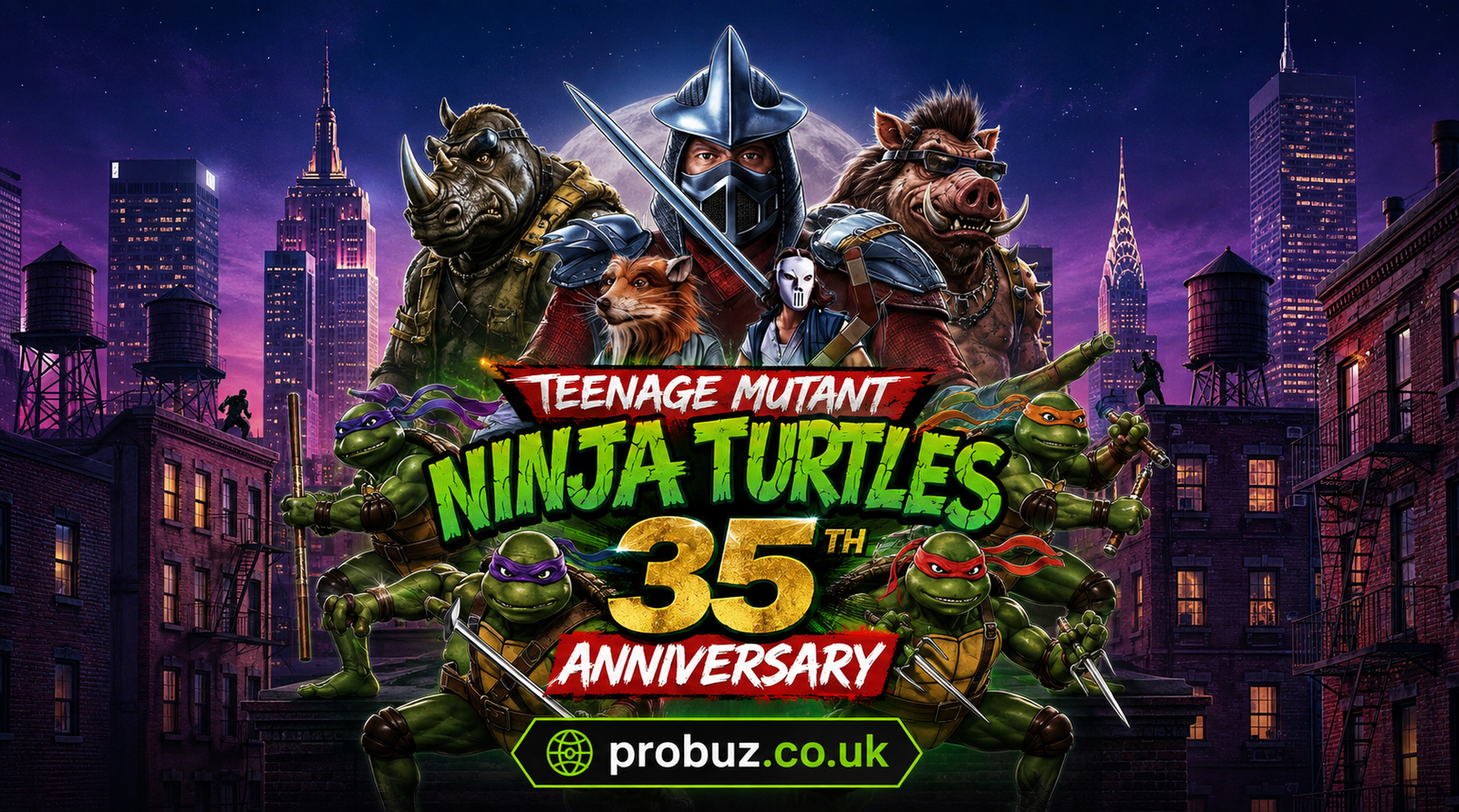
The Teenage Mutant Ninja Turtles 35th anniversary was more than a birthday for four fictional reptiles. It marked 35 years since a strange little black-and-white comic introduced Leonardo, Donatello, Raphael, and Michelangelo to the world.
The anniversary was officially celebrated in 2019, because the original Teenage Mutant Ninja Turtles comic debuted in May 1984. Mirage’s own archive identifies the first printing of Teenage Mutant Ninja Turtles #1 as May 1984, created by Kevin Eastman and Peter Laird.
What makes that milestone interesting is where TMNT started. There was no giant entertainment machine behind the first comic. Eastman and Laird began with an independently published black-and-white book, and the first print run was only a few thousand copies. From that modest beginning came cartoons, action figures, video games, movies, comics, clothing and generations of fans.
The 35th anniversary gave longtime fans a chance to look back at that unlikely journey—and gave newer fans a reason to discover where the Turtles really came from.
Quick Answer: When Was the Teenage Mutant Ninja Turtles 35th Anniversary?
The Teenage Mutant Ninja Turtles celebrated their 35th anniversary in 2019.
The milestone traces back to the publication of Teenage Mutant Ninja Turtles #1 in May 1984. The issue was published by Mirage and credited Kevin Eastman and Peter Laird as its creators. The original book was an oversized black-and-white comic, a far cry from the brightly colored multimedia franchise most people know today.
Nickelodeon and the wider TMNT brand marked the anniversary with events, merchandise and special releases. One notable celebration was the Paley Center for Media’s “35 Years of TMNT” exhibition, which opened in New York on May 18, 2019. It presented a timeline covering the Turtles’ development from their comic-book beginnings through later television incarnations.
So if you’re searching for the TMNT 35th anniversary, 2019 is the key year.
How the Teenage Mutant Ninja Turtles Started
The original TMNT story is almost the opposite of what you’d expect from a major franchise.
Kevin Eastman and Peter Laird were independent artists who created the characters in the early 1980s. Their first comic wasn’t designed as a television property or a toy line. It was an unusual independent comic that mixed martial arts, superheroes, humor and a deliberately offbeat concept.
Mirage’s archive describes the beginnings as a self-published black-and-white comic produced by Eastman and Laird in their homes. The first issue had an initial print run of just 3,275 copies.
That small number matters because it helps explain just how unlikely the later success was.
The first issue was also very different in tone from some of the later cartoons. It was created as a comic first, with a darker and more satirical edge. The original story introduced the four turtles as well as characters such as Splinter and the Shredder.
The first issue went on sale in May 1984, with the Grand Comics Database recording a May 5 on-sale date and a $1.50 cover price.
That little comic became the foundation for everything that followed.
Why the Four Turtles Still Work
Part of TMNT’s longevity comes down to a simple idea: the four brothers aren’t interchangeable.
Leonardo is generally the disciplined leader.
Raphael is the hothead and aggressive fighter.
Donatello is the technology-minded problem solver.
Michelangelo is the fun-loving comic relief.
Those basic personalities give writers plenty to work with. A story can be about teamwork, sibling rivalry, responsibility, humor or simply four friends trying to survive another ridiculous night in New York.
Their differences also make the characters easy to recognize.
Nickelodeon’s current character material still emphasizes those individual traits. Leonardo is presented as the older brother who sees himself as a leader, while Raphael is portrayed as passionate, tough and quick to act.
That’s one reason the franchise can keep reinventing itself without completely losing its identity.
Change the animation style, update the jokes, redesign the costumes or introduce a new generation of viewers, and the basic four-brother dynamic still works.
The Characters Were Named After Renaissance Artists
One of the most recognizable details about TMNT is also one of its cleverest.
The four turtles are named after famous Renaissance artists:
Leonardo — Leonardo da Vinci
Raphael — Raphael
Donatello — Donatello
Michelangelo — Michelangelo
It is a wonderfully strange contrast. These are teenage mutant turtles trained as ninjas, yet their names come from some of the most famous artists in European history.
The naming also became part of the franchise’s personality. Nickelodeon’s character information continues to identify Leonardo with Leonardo da Vinci and Raphael with the Renaissance painter Raphael.
That unusual combination—art history, martial arts, mutants and pizza—is exactly the sort of odd mixture that makes TMNT memorable.
From Cult Comic to Mainstream Phenomenon
The Teenage Mutant Ninja Turtles didn’t remain an underground comic for long.
Television changed everything.
The animated series helped turn the characters into household names, while toys and other merchandise made the Turtles visible far beyond comic shops. The franchise developed an enormous youth audience, and the characters became recognizable even to people who had never read the original Mirage comics.
This is an important part of understanding the 35th anniversary.
TMNT isn’t simply one successful comic. It’s a franchise that has repeatedly been rebuilt for new audiences.
Nickelodeon now describes its TMNT library as spanning the original comic-based incarnation, the 2003 series, Rise of the Teenage Mutant Ninja Turtles, and the 2023 movie Teenage Mutant Ninja Turtles: Mutant Mayhem.
Each version makes different choices.
Some lean harder into action. Others emphasize comedy, family relationships or teenage awkwardness. The visual styles can be dramatically different.
Yet people still know who Leo, Raph, Donnie and Mikey are.
That’s the real achievement.
The 35th Anniversary Wasn’t Just About Looking Back
A good anniversary doesn’t simply put old artwork in a display case. It reminds people why the property mattered in the first place.
In 2019, the Paley Center’s 35 Years of TMNT exhibit did exactly that. The exhibition included artwork related to the original comic and a visual timeline showing how the Turtles evolved from their earliest comics to Nickelodeon’s Rise of the Teenage Mutant Ninja Turtles.
There were also special comics and collectibles tied to the anniversary.
IDW’s 35th-anniversary box set, for example, revisited early Mirage material by collecting TMNT #1–4 and the Raphael Micro-Series in an oversized format.
That approach was especially fitting because it connected modern TMNT fandom with the source material.
For someone who discovered the Turtles through a cartoon or movie, the anniversary was an invitation to see what Eastman and Laird originally created.
Why the Original Comic Still Matters
It’s tempting to think of the original comic as simply the first version of a much bigger franchise.
It’s more than that.
The original TMNT comic explains why the property has always had room for experimentation. The creators weren’t starting with a carefully designed corporate formula. They were playing with ideas, influences and visual storytelling.
The first issue was black and white and independently published, with Eastman and Laird handling the creative work themselves. Mirage’s archive preserves the original issue as the starting point of Volume One.
That history helps explain why TMNT can accommodate wildly different interpretations.
The franchise has never had to look exactly one way.
That’s unusual for a property that has survived for decades.
TMNT Movies Added Another Layer
For many fans, the live-action films are just as important as the comics and cartoons.
The first live-action Teenage Mutant Ninja Turtles movie arrived in 1990, bringing the characters to the big screen with physical turtle suits and a tone that reflected some of the darker elements of the original comic.
The movie became a major part of TMNT history, and its 35th anniversary was subsequently marked in 2025 with a special edition graphic novel adaptation from IDW. That edition revisits the movie adaptation with updated colors, Eastman’s rough layouts and additional material.
This creates an interesting distinction for anyone researching the phrase “TMNT 35th anniversary.”
There is the 35th anniversary of the franchise in 2019, based on the 1984 comic.
There is also a 35th anniversary of the original 1990 movie in 2025.
They are different milestones, and confusing them can lead to incorrect dates.
Why TMNT Keeps Finding New Fans
The Turtles have one advantage that many older franchises don’t: they’re extremely adaptable.
A new creator can change the visual design without destroying the concept. A new writer can shift the tone. A new animated series can make the characters younger, stranger or funnier. A movie can emphasize the family relationship.
The central ingredients remain recognizable:
four brothers + martial arts + mutation + New York + Splinter + villains + humor.
That’s enough structure to create something familiar without forcing every generation to watch exactly the same version.
Mutant Mayhem, for example, emphasized the teenage side of the characters and their desire to experience ordinary life outside the shadows. Nickelodeon describes the story around the brothers trying to win acceptance in New York while working with April O’Neil.
That is a smart reminder of what the word “teenage” in the title can actually mean.
They’re not merely small superheroes. They’re brothers who are still figuring themselves out.
What Makes the 35th Anniversary Important to Fans?
The biggest value of the anniversary is perspective.
If you only know TMNT from modern movies or cartoons, it’s easy to assume the franchise was always a giant property. It wasn’t.
It began with two artists, a strange idea and a self-published comic.
That origin story is arguably as entertaining as many of the adventures that came afterward.
The anniversary also highlighted how much the franchise had changed while keeping its central characters intact. From black-and-white independent comics to animated television, toys, live-action films and modern computer animation, TMNT has repeatedly crossed generations.
And there’s something reassuring about that.
A child who discovered Michelangelo through a recent movie can still become interested in the same four characters someone else discovered decades earlier.
The costumes may change. The animation may change. The jokes certainly change.
The brothers remain.
Expert Insight: The Secret Is Flexibility, Not Nostalgia
The easiest explanation for TMNT’s longevity is nostalgia, but that only tells part of the story.
Nostalgia can bring older fans back, but it doesn’t automatically create new ones.
TMNT has survived because the property allows creators to reinterpret it.
The original comic is one version. The classic animated era is another. Later television series introduced different interpretations. Mutant Mayhem brought the characters into another generation’s visual and storytelling language. Nickelodeon’s own TMNT material now presents several of these eras side by side.
That flexibility is probably more important than simply keeping everything unchanged.
The best long-running franchises understand that preserving a character doesn’t necessarily mean preserving every detail around that character.
For TMNT, the heart of the concept has always been the brothers.
As long as Leonardo, Raphael, Donatello and Michelangelo have a reason to argue, laugh, train and fight together, there is still a TMNT story to tell.
How to Explore TMNT Beyond the Anniversary
If you’re a newer fan and want to understand why the Teenage Mutant Ninja Turtles 35th anniversary received so much attention, don’t limit yourself to one movie or TV series.
A useful path is:
Start with the original comic. It shows how different the earliest version was.
Watch an animated incarnation. This demonstrates how the characters were adapted for a wider audience.
Try one of the modern versions. You’ll see how much the tone and animation have evolved.
Compare the four brothers. Their personalities are the thread connecting most versions.
Look at the villains and supporting cast. Characters such as Splinter, April O’Neil and the Shredder are essential to understanding the wider TMNT world.
Nickelodeon’s official TMNT hub currently provides material from multiple eras, including clips and information about the characters and different series.
The point isn’t to decide which version is “the correct one.”
It’s to see how the same basic idea can survive several generations.
Final Takeaway
The Teenage Mutant Ninja Turtles 35th anniversary in 2019 celebrated a franchise that had already traveled an extraordinary distance from its May 1984 comic-book debut.
Kevin Eastman and Peter Laird’s original black-and-white comic started small, but the concept proved remarkably adaptable.
The Turtles became television characters, movie stars, toy icons and eventually heroes for new generations who weren’t even born when the first comic appeared.
That’s what makes the anniversary worth remembering.
TMNT didn’t survive for 35 years simply because people remembered the past. It survived because each new era found something useful in four brothers living beneath New York, training as ninjas, eating pizza and getting into trouble.
Visit also : probuz.co.uk
When was the Teenage Mutant Ninja Turtles 35th anniversary?
The Teenage Mutant Ninja Turtles celebrated their 35th anniversary in 2019. The milestone was based on the debut of Teenage Mutant Ninja Turtles #1 in May 1984.
Who created the Teenage Mutant Ninja Turtles?
Kevin Eastman and Peter Laird created the Teenage Mutant Ninja Turtles. Their original comic was independently published through Mirage and debuted in 1984.
What year did the first TMNT comic come out?
The first Teenage Mutant Ninja Turtles comic came out in May 1984. The first issue was an oversized black-and-white publication from Mirage.
Who are the four Teenage Mutant Ninja Turtles?
The four main Turtles are Leonardo, Raphael, Donatello and Michelangelo. Their names were inspired by Renaissance artists.
Why are the Ninja Turtles named after artists?
Kevin Eastman and Peter Laird gave the turtles Renaissance-inspired names. The unusual naming choice became one of the franchise’s most recognizable details, with Leonardo, Raphael and Michelangelo among the artists represented.
Was there a TMNT 35th anniversary movie?
There was no single movie created specifically as the 2019 franchise-wide 35th anniversary celebration. The 35th anniversary was marked through events, exhibitions, comics and merchandise. The Paley Center’s 2019 35 Years of TMNT exhibition was one of the notable celebrations.
Is the 35th anniversary connected to the 1990 TMNT movie?
Not originally. The franchise’s 35th anniversary was in 2019, counting from the 1984 comic. The original live-action movie was released in 1990, so its own 35th anniversary fell in 2025. IDW later published a special edition celebrating that movie milestone.
Are the original TMNT comics still relevant?
Yes. The original comics provide the foundation for the characters and offer a very different experience from many later animated and movie adaptations. Anniversary collections and reprints have helped introduce that early material to newer readers.